Thursday, July 25, 2013

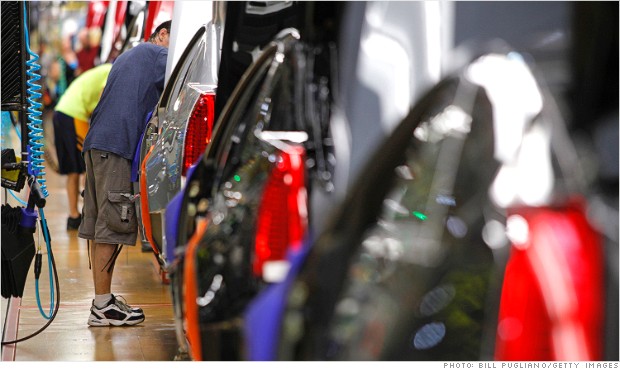
GM narrows European loss, improves profit at home

general motors earnings 072513
General Motors reported strong earnings in North America and smaller losses in Europe.
NEW YORK (CNNMoney)

General Motors reported improved second-quarter earnings in its home market and cut its losses in Europe, but lower earnings in China resulted in a drop in its overall profit.

GM said Thursday it earned $1.2 billion, or 75 cents a share, in the quarter, down from $1.5 billion it earned a year earlier. But excluding special items, the drop in earnings was not as bad as forecast by analysts surveyed by Thomson Reuters, and shares of GM (GM,Fortune 500) rose in premarket trading.
Revenue rose $1.1 billion to $38.2 billion, as the number of vehicles sold worldwide rose 4% to 2.5 million. Sales volume was flat in China, now the largest market for car sales, and down in Europe, but increased 7% in North America.
Earnings in North America rose 4% to just under $2 billion on the improved sales, and the company also hired 6% more North American workers from a year earlier, primarily white collar jobs such as engineers. It also trimmed prior-year losses in Europe by 72%, taking losses down to $110 million. But earnings in the international unit that includes China and Asia tumbled 64% to $228 million.
The results were similar to those reported Wednesday by rival Ford Motor (F, Fortune 500), which also beat forecasts and raised its earnings guidance on reduced losses in Europe and strong North American results. To top of page

House passes defense spending bill, rejects effort to cut off NSA surveillance program

The House of Representatives passed a $598.3 billion defense spending bill Wednesday, while rejecting an amendment to the bill that would have challenged the National Security Agency’s collection of millions of Americans’ phone records, in a debate that clashed privacy rights against the fight to thwart terror.
The defense spending bill passed 315 to 109. The amendment was voted down 217-205 on an issue that created unusual political coalitions in Washington, with libertarian-leaning conservatives and liberal Democrats pressing for the change against the Obama administration, the Republican establishment and Congress' national security experts.
94 Republicans and 111 Democrats voted for the amendment, while 134 Republicans and 83 Democrats voted no.
The showdown vote marked the first chance for lawmakers to take a stand on the secret surveillance program since former NSA systems analyst Edward Snowden leaked classified documents last month that spelled out the monumental scope of the government's activities.
It is unlikely to be the final word on government intrusion to defend the nation and Americans' civil liberties.
"Have 12 years gone by and our memories faded so badly that we forgot what happened on Sept. 11?" Rep. Mike Rogers, R-Mich., chairman of the Intelligence committee, said in pleading with his colleagues to back the program during House debate.
Republican Rep. Justin Amash of Michigan, chief sponsor of the repeal effort, said his aim was to end the indiscriminate collection of Americans' phone records.
After the vote, Amash could barely hide his frustration, telling reporters: “Ask the American people if the House did the right thing."
His measure, offered as an addition to the defense spending bill, would have canceled the statutory authority for the NSA program, ending the agency's ability to collect phone records and metadata under the USA Patriot Act unless it identified an individual under investigation.
Amash told the House that his effort was to defend the Constitution and "defend the privacy of every American."
The unusual political coalitions were on full display during a spirited but brief House debate.
"Let us not deal in false narratives. Let's deal in facts that will keep Americans safe," said Rep. Michele Bachmann, R-Minn., a member of the Intelligence committee who implored her colleagues to back a program that she argued was vital in combatting terrorism.
But Rep. Jim Sensenbrenner, R-Wis., a senior member of the Judiciary Committee who helped write the Patriot Act, insisted "the time has come" to stop the collection of phone records.
Several Republicans acknowledged the difficulty in balancing civil liberties against national security, but expressed suspicion about the Obama administration's implementation of the NSA programs -- and anger at Director of National Intelligence James Clapper.
"Right now the balancing is being done by people we do not know. People who lied to this body," said Rep. Mick Mulvaney, R-S.C.
He was referring to Clapper who admitted he gave misleading statements to Congress on how much the U.S. spies on Americans. Clapper apologized to lawmakers earlier this month after saying in March that the U.S. does not gather data on citizens -- something that Snowden revealed as false by releasing documents showing the NSA collects millions of phone records.
With a flurry of letters, statements and tweets, both sides lobbied furiously in the hours prior to the vote in the Republican-controlled House. In a last-minute statement, Clapper warned against dismantling a critical intelligence tool.
Since the Sept. 11, 2001, attacks, Congress has authorized -- and a Republican and a Democratic president have signed -- extensions of the powers to search records and conduct roving wiretaps in pursuit of terrorists.
Two years ago, in a strong bipartisan statement, the Senate voted 72-23 to renew the Patriot Act and the House backed the extension 250-153.
Since the disclosures this year, however, lawmakers have said they were shocked by the scope of the two programs -- one to collect records of hundreds of millions of calls and the other allowing the NSA to sweep up Internet usage data from around the world that goes through nine major U.S.-based providers.
Although Republican leaders agreed to a vote on the Amash amendment, one of 100 to the defense spending bill, time for debate was limited to 15 minutes out of the two days the House dedicated to the overall legislation.
The White House and the director of the NSA, Army Gen. Keith Alexander, made last-minute appeals to lawmakers, urging them to oppose the amendment. Rogers and Rep. C.A. Dutch Ruppersberger, D-Md., leaders of the House Intelligence committee, implored their colleagues to back the NSA program.
Eight former attorneys general, CIA directors and national security experts wrote in a letter to lawmakers that the two programs are fully authorized by law and "conducted in a manner that appropriately respects the privacy and civil liberties interests of Americans."
White House press secretary Jay Carney issued an unusual, nighttime statement on the eve of Wednesday's vote, arguing that the change would "hastily dismantle one of our intelligence community's counterterrorism tools."
Proponents of the NSA programs argue that the surveillance operations have been successful in thwarting at least 50 terror plots across 20 countries, including 10 to 12 directed at the United States. Among them was a 2009 plot to strike at the New York Stock Exchange.
Rogers joined six GOP committee chairmen in a letter urging lawmakers to reject the Amash amendment.
"While many members have legitimate questions about the NSA metadata program, including whether there are sufficient protections for Americans' civil liberties," the chairman wrote, "eliminating this program altogether without careful deliberation would not reflect our duty, under Article I of the Constitution, to provide for the common defense."
The overall defense spending bill would provide the Pentagon with $512.5 billion for weapons, personnel, aircraft and ships plus $85.8 billion for the war in Afghanistan for the next budget year.
The total, which is $5.1 billion below current spending, has drawn a veto threat from the White House, which argues that it would force the administration to cut education, health research and other domestic programs in order to boost spending for the Pentagon.
In a leap of faith, the bill assumes that Congress and the administration will resolve the automatic, across-the-board spending cuts that have led the Pentagon to furlough workers and cut back on training. The bill projects spending in the next fiscal year at $28.1 billion above the so-called sequester level.
By voice vote, the House backed an amendment that would require the president to seek congressional approval before sending U.S. military forces into the 2-year-old civil war in Syria.
Rep. Trey Radel, R-Fla., sponsor of the measure, said Obama has a "cloudy foreign policy" and noted the nation's war weariness after more than 10 years of conflict in Iraq and Afghanistan.
The administration is moving ahead with sending weapons to vetted rebels, but Obama and members of Congress have rejected the notion of U.S. ground forces.
The House also adopted, by voice vote, an amendment barring funds for military or paramilitary operations in Egypt. Several lawmakers, including Rep. Kay Granger, R-Texas, who heads the panel overseeing foreign aid, expressed concerns about the measure jeopardizing the United States' longstanding relationship with the Egyptian military.
The sponsor of the measure, Rep. Thomas Massie, R-Ky., insisted that his amendment would not affect that relationship.
The overall bill must be reconciled with whatever measure the Democratic-controlled Senate produces.
George H.W. Bush shaves head to show support for young leukemia patient


Former President George H.W. Bush has done it all — bailing out of a fiery plane in World War II, serving as president and, more recently, sky-diving and developing a reputation as a fashion trendsetter with brightly colored socks that don’t always match.
Now he has shaved his head.
But not for just any reason.
The 89-year-old decided to lose his hair this week to show support for a 2-year-old boy fighting leukemia.
Bush noticed that many members of his Secret Service detail had shaved their heads to show support for the boy — Patrick, the son of a member of the security team — who is undergoing treatment and had started losing his hair.
Members of the Bush Protective Division also set up a website to help with the boy’s medical bills and organized a motorcycle benefit next month in Kennebunkport, Maine, to raise money for treatment.
“Once President and Mrs. Bush learned of this ‘Patrick’s Pals’ effort, they made a donation and President Bush volunteered to shave his head as well,” according to a statement from Bush’s office. “The Bushes lost their second child, Robin, to leukemia 60 years ago this October at the age of four.”
George W. Bush was their first child, born in 1946. Pauline Robinson Bush — known as Robin — was born in 1949. She was diagnosed with leukemia shortly after her brother Jeb was born in 1953.
Former first lady Barbara Bush has spoken emotionally about the events, most notably in an interview with her granddaughter Jenna Bush Hager for the Today show on NBC.
She recalled asking the doctor what the family should do about Robin’s prognosis.
“She said, ‘You don’t do anything. She’s going to die,’” Barbara Bush said in the interview. “She said, ‘My advice is to take her home, love her. In about two weeks, she’ll be gone.’”
The Bushes did not take that advice. Rather, they sought aggressive treatment, but she passed away in 1953, several months after the diagnosis.
“I was combing her hair and holding her hand,” Barbara Bush said in the NBC interview. “I saw that little body. I saw her spirit go.”
The Bushes worked hard through the years to raise money for leukemia and cancer research. In honor of their efforts, officials at the M.D. Anderson Cancer Center in Houston opened the Robin Bush Child and Adolescent Clinic in 2004.
In the interview, Barbara Bush said the family takes comfort in the progress made against leukemia.
“It made Gampy and me feel that something good is coming out of this precious little life. And today, almost nobody dies of leukemia.”

Read more here: http://www.star-telegram.com/2013/07/24/5026228/george-hw-bush-shaves-his-head.html#storylink=cpy

Driver investigated after 78 killed in Spain train crash

Death toll at 77 in Spanish train derailment (00:58)
(Reuters) - Police put the driver of a Spanish train under investigation on Thursday after at least 78 people died when it hit a sharp bend at speed and derailed near the northern city of Santiago de Compostela, in one of Europe's worse rail disasters.
Dramatic video footage from a security camera published on the website of El Pais newspaper showed the train careering into a wall at the side of the track as it came off the rails on the bend on Wednesday night.
Police had put the train driver under formal investigation, a spokeswoman for Galicia's Supreme Court told Reuters, without naming him.
The Galicia government said the train had two drivers and one was in hospital but it was not immediately clear which driver was under investigation.
Newspaper reports cited witnesses as saying driver Francisco Jose Garzon, who helped rescue victims, had shouted: "I've derailed! What do I do?" into a phone.
El Pais said one of the drivers was trapped in his cabin and told the railway station by radio that the train entered the bend at 190 kilometers per hour (120 mph).
"We're only human! We're only human!" he told the station, the newspaper said, citing sources close to the investigation. "I hope there are no dead, because this will fall on my conscience."
The disaster happened on the eve of a major religious festival in the ancient northwestern city at 8.41 p.m. (1841 GMT/ 2:41 p.m. EDT) on Wednesday. Officials said several nationalities were among the 130 injured, of whom 36 including four children, were in serious condition.
In what one local official described as a scene from hell, bodies covered in blankets lay strewn around the train track next to overturned carriages as smoke billowed from the wreckage and bloodied passengers staggered away.
Cranes were still pulling out mangled debris on Thursday morning, 12 hours after the crash. Emergency workers had stopped their search for survivors, the court spokeswoman said.
SPEEDING LIKELY CAUSE
One official source said speeding was a likely cause of the derailment, but the public works minister said it was too early to say exactly what had happened.
El Pais cited sources close to the investigation as saying the train was travelling at more than twice the speed limit for the sharp curve and Santiago's mayor said the train was probably going too fast.
The train driver had been sedated, said Juan Jesus Garcia, the secretary general of the Renfe train drivers union, adding he hoped to visit him on Thursday.
He had been operating trains in the area for three years, Garcia said.
Neighbors ran to the site to help emergency workers tend to the wounded. Ana Taboada, a 29-year-old hospital worker, was one of the first on the scene.
"When the dust lifted I saw corpses. I didn't make it down to the track, because I was helping the passengers that were coming up the embankment," she told Reuters. "I saw a man trying to break a window with a stone to help those inside get out."
"We heard a massive noise and we went down the tracks. I helped get a few injured and bodies out of the train. I went into one of the cars but I'd rather not tell you what I saw there," Ricardo Martinez, a 47-year old baker from Santiago de Compostela, told Reuters.
Prime Minister Mariano Rajoy, who was born in Santiago de Compostela, the capital of Galicia region, visited the site and the main hospital on Thursday. He declared three days of official national mourning for the victims of the disaster
The Santiago de Compostela train operated by state rail company Renfe, which had 247 people on board, derailed as the city prepared for the renowned festival of Saint James, when thousands of Christian pilgrims from across the world pack the streets.
The city's tourism board said all festivities, including the traditional High Mass at the centuries-old cathedral, had been cancelled as the city went into mourning following the crash.
Passenger Ricardo Montesco told Cadena Ser radio station the train approached the curve at high speed, twisted and wagons piled up one on top of the other.

"A lot of people were squashed on the bottom. We tried to squeeze out of the bottom of the wagons to get out and we realized the train was burning. ... I was in the second wagon and there was fire. ... I saw corpses," he said.

Wednesday, July 24, 2013

Google expected to unveil new Nexus tablets in battle of mobile devices Read more: http://www.foxnews.com/tech/2013/07/24/google-next-generation-nexus-tablets/#ixzz2ZyHc3utP

  • Google Nexus 7 tablet.jpg
    The Google Nexus 7, a tablet from the Internet giant that runs the Android operating system and competes with Apple's iPad. (Google)
Google is expected to unveil the next generation of its Nexus tablets Wednesday in its latest challenge to Apple's market-leading iPad and Amazon.com's Kindle Fire.
The new devices are likely to be the main attraction at a San Francisco event being hosted by Google Inc. executive Sundar Pichai, who oversees the company's Android and Chrome operating systems. The Nexus line of tablets that came out a year ago all run on the Android software that also powers hundreds of millions of smartphones.
Google hasn't revealed the reason for Wednesday's event, which is scheduled to start at 9 a.m. PDT.
But pictures of what's purported to be the upgraded versions of the Nexus tablet have been posted on the Internet during the past few days, fueling speculation that Google is poised to release the new devices.
The current versions of the Nexus tablets feature seven-inch and 10-inch displays and are set up to encourage users to buy music, video and applications from Google's Play store.
Since its introduction last summer, the seven-inch model has proven particular popular among consumers looking for a less expensive alternative to Apple's iPad. A Nexus 7 with 16 gigabytes of storage, sells for $199, the same price as a Kindle Fire HD with a seven-inch display. That compares to $499 for an iPad with a 10-inch screen and the same amount of storage. Google sell a Nexus with a 10-inch display and the same amount of storage for $399.
The popularity of the less expensive and smaller Nexus and Kindle Fire tablets is one of the main reasons that Apple released the iPad Mini with an eight-inch screen last year. Apple sells its smaller tablet for $329.


Read more: http://www.foxnews.com/tech/2013/07/24/google-next-generation-nexus-tablets/#ixzz2ZyHZyeh2

U.S. marketers greet royal baby with cute ads


Everyone wants a piece of the royal baby — particularly marketers. The marketing tweets have taken social media by storm.

SHARE 57 85 2COMMENTMORE
If the royal baby could collect royalties from all the marketers welcoming him to the world, he'd be royally rich.
Even as British marketers have been going gaga over the royal baby for months, with his birth on Monday, a flood of U.S. marketers are suddenly latching on, too, including Coca-Cola, Johnson & Johnson, Pizza Hut, Craftsman Tools and Pampers. Most are going the social media route.
For marketers, it's all about linking their brands with one of pop culture's — and social media's — biggest happenings. As of midday Tuesday, the royal baby had been mentioned in more than 2 million tweets, reports Twitter. Interest in the royal birth is particularly keen for marketers who often have a difficult time finding upbeat news events with which to associate their products.
Even the cynics get it. "This does help advertisers because, unfortunately, we are all caught up in the royal family," says pop culture expert Elayne Rapping.
A PRINCE IS BORN: The royal baby arrives
But the tie-ins will only work for advertisers that make a logical connection to the baby's birth, says Allison Cohen, owner of PeopleTalk Research.
Among the baby-welcomers:
• Johnson & Johnson. The baby products maker tweeted out a photo of a baby in a bathtub wearing an apparent crown made from baby shampoo bubbles. It also plans to run a print ad in People magazine featuring a baby's hand holding onto a mother's finger under the headline: "A parent's love is the same the world over."
• Coke. The cola giant tweeted out a photo of two toasting Coke bottles, one labeled Wills and the other labeled Kate. The tweet read, "Time for a royal celebration."
• Pampers. The diaper maker tweeted out a video stuffed with heart-tugging shots of babies under this headline: Every Little Baby is a Prince or Princess.
• Pizza Hut. Through Thursday, the pizza chain has rolled out an online only deal celebrating the royal baby. Folks who order large or medium pizzas and put the words ROYALOFFER in the promo code will receive one free side dish. "One of the last things new parents want to worry about is what's for dinner," says spokesman Doug Terfehr.
• Dunkin' Donuts. The doughnut chain on Tuesday rolled out the "Royal Munchkin," a box of doughnut holes dipped in pink-and-blue sprinkles. Why? "To make the moment a little sweeter," says Nigel Travis, Dunkin' Brands CEO, who is a dual U.S. and British citizen.
• Craftsman tools. William and Kate may live in a palace, but they still have to think about how to baby-proof their home, says Ryan Ostrom, chief marketing officer at Craftsman tools. So Craftsman has posted new videos — for first-time moms and dads — about how to do just that.
• Oreo. The cookie brand tweeted out a simple photo: An Oreo and milk-filled baby bottle sitting atop a very royal-looking, plush, velvet cushion. The tweet offers this: "Prepare the royal bottle service!"

Most passengers rescued after asylum seekers boat sinks off Indonesia


(Reuters) - Three people died but another 157 suspected asylum seekers were rescued after their boat sank off the southern coast of Indonesia, officials said on Wednesday after earlier reports that as many as 60 may have perished.
The latest case of a boat sinking while attempting the perilous journey came five days after Australia slammed the door on would-be refugees with a deal to send all boat arrivals to Papua New Guinea for assessment and eventual settlement.
The debate over refugees and people smuggling has long been a hot political issue in Australia and has intensified with an election looming in a few weeks.
Earlier on Wednesday, News Ltd and other Australian media reported that the boat was carrying as many as 170 people and that up to 60 were feared dead or missing.
Indonesian emergency authorities however said later that 160 people were on board and that three had died, two women and a 12-year-old boy from Sri Lanka.
"(The survivors) have been taken to a temporary immigration holding facility ... They seem fine," Rochmali, the head of the search and rescue office for West Java, told Reuters.
There were also conflicting reports about the nationalities of those on board. They were described variously as coming from Iran, Iraq and Bangladesh, as well as Sri Lanka.
The boat capsized late on Tuesday after hitting a reef off the coast of Sukapura, about 270 km (170 miles) south of the capital Jakarta, said Rochmali, who like many Indonesians uses one name.
Since 2001, about 1,000 people have died while trying to reach Australia's Indian Ocean territory of Christmas Island in unseaworthy boats. More than 15,000 asylum seekers have arrived by boat in Australian territory this year.
On Friday, Canberra announced tough new measures to stem a sharp increase in the number of refugee boats heading for Australia from Indonesia.
The new plans have been condemned by human rights groups, with Amnesty International accusing it of shirking its moral obligations to help the world's most vulnerable people.
Shortly after Prime Minister Kevin Rudd visited Indonesia this month, Jakarta said it would stop giving Iranians visas on arrival, making it harder for them to use the Southeast Asian country as a route to seek refuge in Australia.
Australia last year reopened immigration detention centers on Manus Island in Papua New Guinea, and on the remote South Pacific island nation of Nauru, in order to deter boat arrivals.
A former guard at Manus Island told Australian television on Tuesday of the poor conditions on Manus and said detainees were sexually abused and tortured by other inmates with no intervention by staff.
Australian Immigration Minister Tony Burke said he would travel to Manus to inspect conditions, but said Australia remained committed to expanding the Manus detention center and to sending all boat arrivals to Papua New Guinea.

The U.N. High Commissioner for Refugees (UNHCR) earlier this month found major shortcomings with the Manus center, with cramped living quarters and asylum seekers reporting issues with the heat, privacy, hygiene and access to medical services.